


Diane von Furstenberg’s life is the stuff that entrepreneurial legends are made of. A visionary who has demonstrated a sixth sense of what women want since launching her legendary wrap dress more than 52 years ago, what makes von Furstenberg truly exceptional is her continued drive to empower women.
This has taken many forms over the course of her life — from the frock that started it all to her autobiographies where she shares lessons learned and life philosophies to her championing of organizations like Vital Voices and the creation of the DVF Awards. Created in 2010, the program honors women who are working to find solutions to the world’s most pressing problems, such as immigration, maternal health and trafficking.
Von Furstenberg’s latest project is a continuation of that work. To mark International Women’s Day, the designer has teamed up with Estée Lauder for the InCharge collection, consisting of a fragrance, a trio of lip glosses and a multi-use blush stick.
The scent, called InCharge Essence d’Eau, $85, is formulated without alcohols; it contains top notes of saffron, mimosa and honeysuckle, a heart of incense, rose, violet and orrize, and a drydown of musk and wood.
There will also be a trio of lip glosses, $45, formulated with jojoba, sunflower and apricot seed oils for moisturization, and a multi-use cheek stick, $35, in a universal pink shade that von Furstenberg said she loves to use on her cheeks and eyes and lips.
The collab will be available at select Estée Lauder counters and at von Furstenberg’s boutique, as well as the websites of both brands.
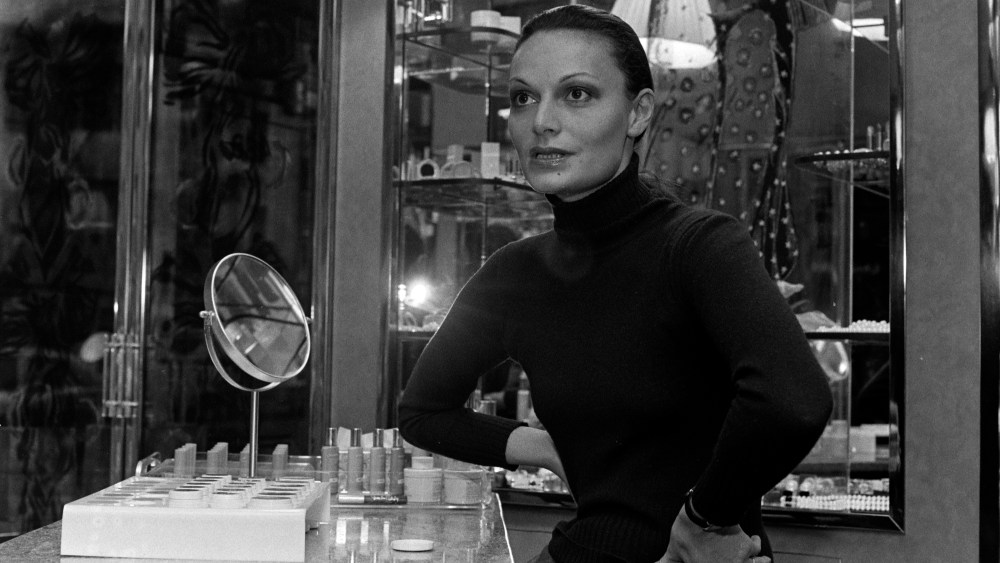
The launch marks a return, of sorts, of von Furstenberg to the beauty arena. In 1974, she created Diane von Furstenberg The Color Authority makeup (tapping her pal Sylvie Chantecaille to help with product development) and opened a store on Madison Avenue where famous friends like Bianca Jagger would pop in for a glow-up. She had a hit fragrance in 1975, named Tatiana after her daughter. Within five years, the makeup and fragrance were doing $50 million.
(“When she gets behind a makeup counter, she can really sell,” Norman Goldberg, the general manager of her beauty division, told WWD in 1976.)
How do you define beauty? What does beauty mean to you?
John Keats said beauty is what beauty does. He also said a thing of beauty is a joy forever, so beauty for me is, first and foremost, nature — a sunset, a flower, anything. Beauty in a woman or in a person is who you are. Children are beautiful, because they are not self-conscious. Beauty is about being who you are — owning it, enjoying it. And love. That’s why it goes back to beauty is what beauty does.
How has your definition of beauty changed as you’ve gotten older?
When I was a little girl I didn’t like the way I looked, because I was so different from everyone else in Belgium. They all had blond straight hair and I had curly hair. Everybody thought I was a little boy, so I didn’t particularly think I was beautiful.
But then I became older and I was surrounded by beauty. My best friend was Marisa Berenson; she was a top model. I worked in Paris, in the business of photographers, so I surrounded by photographers and models and makeup artists and advertising agencies. It was all about beauty and the commerce of beauty.
Then I found my job by working in a factory and making little dresses, and then I got married, became a princess and lived in America and then all of a sudden I found myself on the cover of newspapers and magazines.
I was the person people asked questions to. I remember originally when I went from department store to department store selling my dresses, fashion editors would describe me as the Park Avenue princess and I didn’t really like that, so I became a little bit more provocative.
Very early on I used my voice, and by using my voice I was becoming more and more in charge, which is what I wanted to be in the first place.
What made me a woman in charge — meaning independent, successful, being able to pay my bills — was a little dress. Because it was a little dress I was able to share that with millions of people and it became more than a dress. My dress became a flag of freedom and I became the voice for women. From that moment on, I became that voice.
You had such a big success at such a young age. Did that change the way you felt about your looks?
Even at the peak of your success, you wake up sometimes and feel like a loser. So it’s not like you think you’re on top of the world even when you are. Same thing as when you’re not on top of the world — you don’t feel as low as you seem to be. It is really about the complicity you have with yourself — being able to wink at yourself in the mirror and wave at yourself and have the complicity with yourself.
Do you have a favorite beauty decade — in terms of looks/style?
The ’70s were pretty cool. To be young in New York City in the ’70s was pretty cool and I was extremely successful and I was in my 20s, so that was a great decade. Every decade is good. The 40s I didn’t like so much, the 50s I loved. I compare women to the seasons. Spring is when everything starts and you discover things — the little bud becomes a flower and things grow. Summer is the fruits, and then the fall, the autumn is the beautiful color, and then winter, which is where I am now, hopefully at the beginning, is also beautiful, because you have already had the other three. So you have layers of experiences and layers of souvenirs.

You’re launching a collaboration with Estée Lauder for International Women’s Day. What made you want to get back into the beauty business?
What linked me with Estée Lauder this time is about empowerment of women. I am very much about women in charge and I use my voice and my resources. Everything I do is to make women be the women they want to be. Estée Lauder is also very interested in that and we decided to do a collaboration. I have in my hidden things I had discovered this incredible water-based perfume and we added a cheek stick and a lip gloss and the collaboration is called InCharge and it’s for the woman in charge.
You and Estée Lauder are among the most successful female entrepreneurs in the world. Did you ever meet her? What do you think you had in common with her?
I met her when I first started. She was this queen, an empress in New York City. When we started talking to Estée Lauder, I found a photograph of her and me, and you can see even in the photograph the way she looked at me with approval and protection. So it became a very natural thing.
What do you have in common with her?
She was definitely a woman in charge!
You launched fragrance and makeup in the ’70s. How do fashion and beauty intersect?
You work with different materials, but to me, it’s the same thing — to give women confidence, power and to feel good.
You opened a beauty store on Madison Avenue. Where do you like to buy products today and why? What did you learn about how women think about their self-image that made a lasting impression on you?
That was so insane! I was afraid to go to a Bloomingdale’s counter, so I opened a makeup shop!
The important thing is to help a woman find the right tools — the right dress, color, perfume — that will fit her and make her feel good. Whether she can buy it online or in a shopping experience, it is about the communication you have with a woman and being able to translate that.
Listen, I have done more personal appearances than anyone. When I had a makeup line, I did more makeovers, I went around the country doing makeup — 7 minutes boom. Me and my makeup artist, we used to think we were rock ‘n’ roll stars on a tour. I know, when you do makeup on a woman, it’s not just the makeup. It’s the words.
You published your “Book of Beauty” in 1976. In it, you write about how you and Marisa Berenson used to use a clothing iron to literally straighten your hair. What’s the craziest thing you’ve done for beauty recently?
Hmmm. What have I done crazy for beauty? At some point you get into your life and realize beauty really is who you are. So it’s not about hiding who you are, but it’s about owning who you are. It is about taking care of your body and all of that — I’m a big swimmer and walker — but I’m not so much high maintenance.
You also write that you’re not about plastic surgery and constantly chasing a youthful appearance.
I agree with that more than ever. There is nothing better than having lived. Having lived is your wealth. That is why I always say, even to a little child, instead of saying ‘how old are you?’, I say, ‘how many years have you lived?’ The years become pride.
You weren’t yet 30 when you wrote the book. If you were writing it today, what would be the same/different?
It’s all about confidence and owning it and owning who you are and making the best and not comparing yourself with anyone. Be you. If I had to write a beauty book today, I would call it “Be You.”