




This is Bloomingdale’s moment.
The upscale department store is riding a string of quarterly comparable-store gains, has stepped up investments in renovations, and is capitalizing on disruption in the industry, notably the Saks Global bankruptcy.
As chief merchant Denise Magid and her team visit showrooms, tour the brands’ own specialty stores, and create customized “pitch decks” for brand-specific and seasonal campaigns, the goal is clear — to bring the most modern and fullest expression of a brand to the Bloomingdale’s audience. And not only to introduce Bloomingdale’s customers to a brand for the first time, but also entice those who might be accustomed to shopping the brand’s store or website.
“Tory Burch is a perfect example,” said Magid, admiring the designer’s fifth-floor shop while touring the store with a guest. “The color, the materials, the brand elevation — it creates a story beyond just product. You feel the DNA of the Tory Burch brand. You feel like you’re in her store, but yet you’re still in Bloomingdale’s.”
With Vuori, the California coastal lifestyle contemporary and active brand, “It became a conversation of how we can bring their brand to life at Bloomingdale’s, give them new customers, but also express their brand in a way that feels right for them?” Magid said. “We didn’t want to just put Vuori on a couple of racks. We wanted to present Vuori powerfully across men’s and women’s. It represents something unique in the active space. They were a DTC brand and have been very strategic and deliberate about their distribution, which I think is a smart strategy.” Vuori will eventually enhance its men’s space at Bloomingdale’s as well.
At the Frame shop, Magid said: “Nicolas [Dreyfus, chief executive officer of Frame] asked me to see his Madison Avenue store, and we went through it. It’s beautiful and I wanted to bring that expression to Bloomingdale’s. And so in our renovations of 59th Street, we expanded Frame’s space, because sportswear has become such an incredible part of the brand. We’re about to put in a Frame shop in our men’s store, too.” Frame is best known for its premium denim but has also built a reputation in contemporary fashion for men and women.
“We are adding many brands across categories,” Magid said. “We added over 3,000 points of distribution just this past year. That’s pretty impressive. But more brands are joining because they see what’s happening at Bloomingdale’s.”
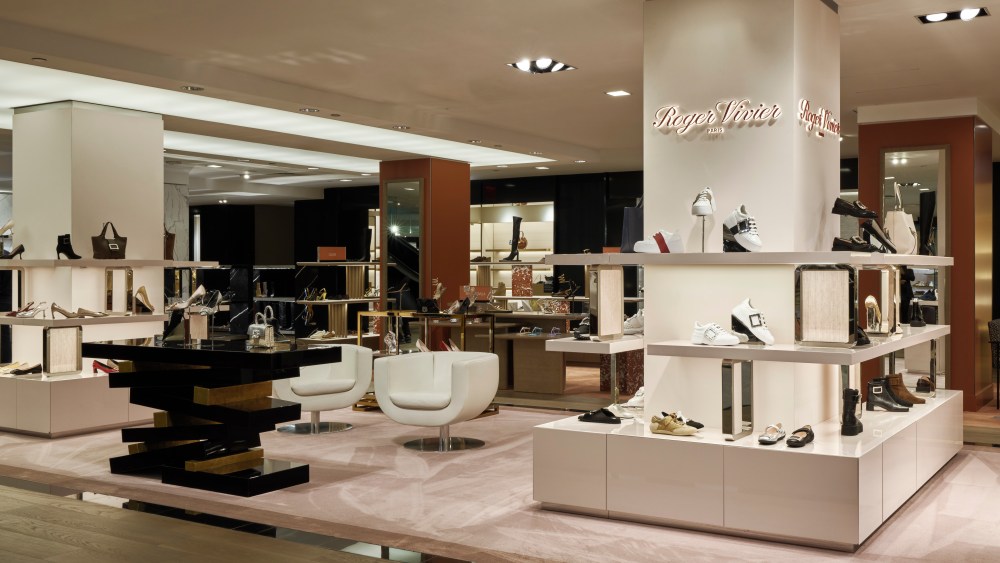
At the 59th Street flagship, renovations are ongoing in designer ready-to-wear, contemporary, the “Arcade” for luxury leather goods and in footwear. Renovations in menswear will happen this year, with several brands being added to the assortment. The beauty spaces at 59th Street will be updated beginning in 2027.
The 868,000-square-foot flagship is said to generate between $500 million and $600 million in sales annually, though executives declined to comment on that. Bloomingdale’s, a division of Macy’s Inc., operates 31 full-line department stores and 25 outlets in the U.S., and e-commerce. In total, Bloomingdale’s generates approximately $4 billion in annual sales, industry sources said, 38 percent of which is online.

Denise Magid
The 59th Street flagship is beaming with new shops from Christian Louboutin, McQueen, Burberry, Valentino, Golden Goose, Frame and Cinq à Sept, to name a few that have opened over the past year. Jil Sander, Loewe shoes, Toteme and Chloé will unveil their own dedicated spaces soon this year, while Bottega Veneta and Fendi reimagine their current boutiques. “Fendi has a beautiful new flagship in Milan, and it was such an incredible experience that we want to bring that type of experience to our store,” said Magid.
Prada is doubling the size of its shop and will create a “fresh” exterior facade on the Lexington Avenue and 60th Street side of the flagship, becoming what could be considered an “anchor” tenant, similar to the long-standing Louis Vuitton shop anchoring the Lexington and 59th Street side of the flagship.
The personal shopping complex on the fourth floor will be overhauled with larger fitting rooms, a bar and space to showcase products. Bloomingdale’s wants clients to spend more time in the store and feel comfortable, which encourages more shopping.
The flagship transformation brings a greater degree of cross-merchandising and, in many cases, all of a brand’s categories are displayed to encourage product discovery and wardrobing. Several contemporary brands with origins in denim, like Frame, have expanded their offerings. L’Agence, a denim and sportswear brand, has added categories such as belts and is expanding with footwear. In luxury, the Peter Marino-designed Chanel duplex that opened last fall displays what Magid described as “the world of Chanel.” A Chanel leather goods and jewelry shop debuts on the arcade later this year. Traversing the women’s floors, there’s a better flow, so one area, for example, contains an array of print-oriented brands; another area would be focused on neutrals.

The new Christian Louboutin shop at Bloomingdale’s 59th Street. Photo by Luis Guillén.
With the Bloomingdale’s 59th Street renovations, “We’re very far along in a lot of the women’s categories. In men’s, we have an incredible business but we really want to continue to refine our point of view,” Magid said.
While touring men’s, she said there’s room to push harder on luxury and also launch “really cool brands.” Magid cites upcoming shops for Casablanca, Fear of God and Willy Chavarria. She foresees the potential for significant growth with emerging designers, as well as classic, tailored clothing. “We definitely will be expanding, adding more brands, and creating more of what you saw in women’s in terms of the strong perimeter shops, with a lot of space for incubating new brands.”
Bernard Dubois of Bernard Dubois Architects, the Brussels-based firm that recreated the flagship’s designer floor, said: “With all the excessive visual stimulation and noise that we have everywhere, it’s important to create spaces where people feel a bit more calm and quiet.”
Dubois created a system of limestone facades behind which designers built their shops along the perimeters of the floor, and several central pads, or pavilions, displaying a group of brands. Each pavilion is delineated by a different color palette to suggest a different style aesthetic or category. These central pads are created for ease of shopping and so smaller brands don’t get lost in the mix. They also help Bloomingdale’s from getting too “shopped out.”

A central pad on the 4th floor of Bloomingdale’s, with Acne Studios to the side. Photo by Adrien Gaut.
Dubois installed drop ceilings and limestone columns to bring symmetry to the 74,540-square-foot fourth floor, which previously felt choppy and disconnected because the flagship is composed of five buildings. “Now when you walk the fully finished project, you would never guess that you’re in different buildings,” said Dubois. “You can really see across the whole project, like looking down a big avenue.”
A warmer, cozier feeling emerges, offsetting some of the familiar flash and high-octane character of Bloomingdale’s. But it’s not like the department store’s DNA is fading. The black-and-white checkerboard flooring, known as the B-way, is still there, and the black “eyelid” framing of many of the designer shops remains evident. But there are iterations of both, in different colors and materials, as subtle nods to the abiding codes of the business.
Warmth is enhanced by how Dubois redesigned fitting rooms with velvet curtains, velvet-cushioned furniture, wall-to-wall carpeting, and high-gloss paint, creating a 1930s look. He has also redesigned the personal shopping complex so it will have bar seating for coffee or a glass of wine, areas for product display and more space.

The fitting rooms have been recreated for comfort. Photo by Adrian Gaut.
Dubois decided to expose more than 30 windows on the floor that for decades were covered because brands wanted to have back walls to maximize displays. “Retail should feel comfortable, calm and also residential. Having natural light is really part of it, and connects you to the city, reminding you that it’s winter or summer, sunny or rainy.”
Whether designing at Bloomingdale’s or another store — Dubois has recreated selling floors for Galeries Lafayette, Alsterhaus, Courrèges and Lanvin, among others — there’s a “low-tech approach with little visible technology,” Dubois said.
“We live in a world where everything is more and more digitalized, but creating a retail space like this is about physical experience, and people come to Bloomingdale’s to have a physical experience. It’s the opposite of shopping online and personally, when our clients ask for video screens for campaigns in their stores for the past few years, I’ve always done my best to refuse. It’s really out of trend.”

Bernard Dubois
Magid said much of her career has been spent “finding those young fashion stars and supporting them on their journey.” At Bloomingdale’s, “We want to find and incubate the next generation of talent and be able to grow these brands.”
Magid began her retail career in the Lord & Taylor executive training program, joined Saks Fifth Avenue where she rose to senior vice president and general merchandise manager, and introduced the concession model in contemporary sportswear to the store. She became chief merchant for Intermix and left a year later to start DVMagid Consulting, where she gained valuable experience working with international and domestic brands. In 2019, Magid joined Bloomingdale’s as GMM and was promoted to chief merchant in 2023.
With Bloomingdale’s transforming, average retail price points are going up. “It’s not monumental. It really depends on the category,” Magid said. Expanding the luxury footprint, “naturally” lifts the pricing. So does selling more fine jewelry. “But honestly, we’ve been trying to hold pricing and we’re keeping opening price points in our mix.” There’s a range, from Aqua, a private brand, with prices under $100, to a $400,000 ultrafine piece of jewelry.
Bloomingdale’s frequently runs sales, though Magid said: “Promotions haven’t gone away completely but we are surgically reducing them and have decreased our discount levels by a significant amount. There are many brands, including many luxury brands, that are not included in promotion. We’re reducing the promotions. We’re really thinking about personalized offers for our clients versus mass promotions. But I will tell you that our full-price business has been stronger than ever.”
Bloomingdale’s does have a concentration of leased designer and contemporary shops, where the merchandising and pricing is controlled by the brands. Asked if the percent of leased versus wholesale shops is growing, Magid replied, “That’s not actually true. There are a lot of brands that are wholesale. It really depends. We choose the brands. The [business] model doesn’t matter. The fundamental consideration is what provides the best experience for the client, and what makes sense for maximizing our brand partnerships. That will vary by brand, depending if they’re great retailers, or if they’re great wholesalers. Customers can’t tell the difference,” between what’s leased or wholesaled. “We encourage all our associates, whether they’re part of the leased operations or wholesale, to service the customer no matter what.”
In exchange for getting a significant and highly visible presence on the selling floor, the designer or manufacturer typically pays for the costs of creating their shop-in-shop.
Beyond 59th Street, “We will be renovating several stores,” Magid said. “There are five regional flagships that we’re very focused on transforming over the next couple of years, and so we’re in the process of that project.” Simultaneous with 59th Street, “We’ve already started work on parts of Century City expanding our luxury shoes, renovating the ready-to-wear floor and the main floor.” Work is also underway at the Glendale, Calif. store, and will also happen at the Tysons Corner, Va., and South Coast Plaza, Calif., stores. The Aventura, Fla., store was recently extensively renovated, but will see some more changes. “Our fine jewelry business in Aventura has been explosive, so we’re expanding that,” Magid said.
“It’s business as usual in terms of continuing to expand and refine our matrix, and strengthen our point of view. But right now, the investment we’re making in the experience is definitely more significant than we have in recent years.”
Bloomingdale’s is a true department store in that it carries a broad spectrum of fashion and home categories and products, albeit with an upscale positioning. The store could still bring in additional categories. “We’re always looking at different categories,” Magid said. “We have an incredible home business which we are evolving, and we are dabbling in more things like food, and then obviously expanding certain categories, like hair care and hair tools. We look at what’s resonating with the customer and what our customer wants from us, and what can be additive to the total experience. It becomes a bit easier to figure out how to expand our mix on the digital side. We launched a marketplace a couple of years ago, and so that has allowed us to expand both the brand mix and new categories, like with electronics, etc., which we do more online than we would do in a physical location.”
Data from the digital side of the business helps inform matrix decisions, such as determining which stores should sell which brands and to what degree. “We like to make sure that we’re very localized,” Magid said. “The beauty of Bloomingdale’s is that with only 31 full-line stores and four Bloomies, we have the ability to really curate each store locally.” Bloomies are scaled-down, contemporary-oriented versions of the full-line Bloomingdale’s department stores.
In the past year, Bloomingdale’s has provided luxury and premier contemporary brands with an additional 3,000 points of distribution, helping to sharpen the store’s point of view. “It’s not just about adding brands,” Magid said. “We’re refining and editing at the same time we’re adding, because we’re really trying to create a stronger customer experience and strengthen the fashion point of view of Bloomingdale’s.”
“At heart, we’re a fashion brand,” Magid said. “When I go into appointments with very big brands, they’re telling me that the customer at Bloomingdale’s wants to see what’s next. They want us to tell them what’s hot, what’s interesting. And that’s our job.”
NEW TO THE MATRIX
Beauty: Biologique Recherche, Victoria Beckham Beauty, Loewe, Dries Van Noten, Brunello Cucinelli Fragrances, Morrocan Oil, Le Bonne Brosse
Men’s: Rhude, Fear of God + Essentials, Casablanca, Willy Chavarria, Nahmias, Common Projects
Women’s: Heirlome, Fforme, Zankov, Liberowe, Toteme, St Agni, Haikure, Jude footwear, Le Monde Beryl, Call It by Your Name
Jewelry: Repossi, David Webb, Harwell Godfrey, Franck Muller, Moritz Glik, By Pariah, Lana